The student exchange I'm about to embark on is a joint program organised by the Centre for Cultural Research (CCR) at UWS where I'm studying and the Advanced Cultural Studies Institute of Sweden (ACSIS). Professor Johan Fornäs, Director of ACSIS, has invited myself and some Post doc students who are visiting ACSIS to participate in an exercise of reflecting on the state of interdisciplinary and critical cultural research in the context of our home countries with particular attention to the following:
- Current developments in the field, concerning research policy, resources and/or intellectual trends
- Most pressing threats and dangers to the field
- Best arguments for cultural studies and cultural research
He has suggested that we write this in two parts - a short essay at the beginning of the visit and a final essay towards the end which would build in any insights from the period of stay in Sweden.
This exercise is a very timely one for me for a number of reasons. Starting my Phd at the beginning of this year has also meant a return and re-engagement with 'cultural studies' after many years away from University. Over the last six months I have actively (and sometimes passively) been making connections and building bridges between my past and current experiences to understand what cultural studies is now, how it has changed and what it means in relation to my own project.
So, with some trepidation and a bout of nerves, I am tackling this exercise in my blog. Why blog it? Well, partly because this journey to Sweden (and the various exercises, meetings, expeditions, contacts and nights out that it may comprise) is a pivotal dimension of my PhD experience and the original raison d'etre of this blog. I have a practical motive too. A blog entry is an effective marker representing the starting point for my reflections on this topic and a point to return to later when I write up the second essay. There is another reason why I'm blogging this exercise and that's because I would love to hear from other bloggers, be they students or not, in Australia or elsewhere, with their views on these questions about 'cultural studies'...
Thursday, October 06, 2005

Wednesday, September 28, 2005
Reflections on a trip to Sweden
Just read Glen's recently updated post written back in October of last year on his experiences while in Norrköping, Sweden. I'm heading off in 10 days and his post suddenly made me feel how real it is - that place over there where I'll be so soon. Cool. And cool it will be too... I have started scrounging around for warm things and dug out the old skiing and bushwalking box to try and get together some garments to withstand the plummeting temparatures of late autumn. You know I had a secret plan (not so secret anymore) that I'd go to IKEA while I'm there.
Sociotechnical capital
Eva Cox sent me a copy of the paper she gave the other day called Reclaiming Social Capital: an exploration of new standpoints and complexities. I found the paper pretty useful and challenging.
I have been thinking how a theory of sociotechnical capital might be relevant for exploring some of the more mysterious aspects of people-technology relations within organisations. I discovered upon googling that a guy called Paul Resnick has adapted the notion of social capital to the sociotechnical domain and is considered to be one of the pioneers in the development of recommender and reputation systems. Not sure if you know about recommender systems. Amazon is a good example of one - you know how when you search for books you get a whole host of ways of mapping the found book/object in relation to what other books customers have bought who have also bought this book, customer reviews and customer book lists (listmania). Very interesting indeed, not least because it represents an attempt to capture social capital as a reusable resource. I was interested in Eva's use of it as a kind of lens for identifying the presence (or absence) of some qualities at the level of the group that could then be analysed using a range of analytical tools.
I found her piece interesting and was drawn to the concept of social capital because it helps to articulate how a group produces social contexts and relations through its interactions, and identifies the role of this dimension as constitutive of the operations of the group and individuals within it. Where I think it has room for expansion and/or adjustment is in the clear separation of the social from the material. For example, bonding can take place between people and objects, as can bridging and linking. In some cases the relation is with the object itself and in others the object plays a mediational role shaping the experience of the connection with others. Trust and distrust play out on these different levels too - think of how you feel when you are having a conversation with someone that you trust over the phone but their phone keeps getting cut off whenever you talk to them. This may not lead you to distrust the person, but it may make you feel less trustful about sharing your thoughts over the phone, which may in some strange way have the same effect, particularly if your primary contact with them is over the phone.
So some of the questions that came up for me included how social capital relates to material capital. Another example, my experience working with many community organisations that were under sustained funding pressure/cuts was that I observed a slow degradation of social capital within the organisation. Yet in some organisations this did not happen and would paradoxically lead to higher social capital. So while they do seem interconnected and the structural elements are important, neither of these things in themselves explain everything.
Other question I had was how S.C. relates to concepts like 'diversity' and this lead me to wondering how compatible it would be with an ecosystem perspective - to help explain and/or identify that there are certain qualities of local ecologies that are a product of the relations that constitute them that contribute to their survival as healthy and robust local systems within a larger heterogenous ecosystem.
I have been thinking how a theory of sociotechnical capital might be relevant for exploring some of the more mysterious aspects of people-technology relations within organisations. I discovered upon googling that a guy called Paul Resnick has adapted the notion of social capital to the sociotechnical domain and is considered to be one of the pioneers in the development of recommender and reputation systems. Not sure if you know about recommender systems. Amazon is a good example of one - you know how when you search for books you get a whole host of ways of mapping the found book/object in relation to what other books customers have bought who have also bought this book, customer reviews and customer book lists (listmania). Very interesting indeed, not least because it represents an attempt to capture social capital as a reusable resource. I was interested in Eva's use of it as a kind of lens for identifying the presence (or absence) of some qualities at the level of the group that could then be analysed using a range of analytical tools.
I found her piece interesting and was drawn to the concept of social capital because it helps to articulate how a group produces social contexts and relations through its interactions, and identifies the role of this dimension as constitutive of the operations of the group and individuals within it. Where I think it has room for expansion and/or adjustment is in the clear separation of the social from the material. For example, bonding can take place between people and objects, as can bridging and linking. In some cases the relation is with the object itself and in others the object plays a mediational role shaping the experience of the connection with others. Trust and distrust play out on these different levels too - think of how you feel when you are having a conversation with someone that you trust over the phone but their phone keeps getting cut off whenever you talk to them. This may not lead you to distrust the person, but it may make you feel less trustful about sharing your thoughts over the phone, which may in some strange way have the same effect, particularly if your primary contact with them is over the phone.
So some of the questions that came up for me included how social capital relates to material capital. Another example, my experience working with many community organisations that were under sustained funding pressure/cuts was that I observed a slow degradation of social capital within the organisation. Yet in some organisations this did not happen and would paradoxically lead to higher social capital. So while they do seem interconnected and the structural elements are important, neither of these things in themselves explain everything.
Other question I had was how S.C. relates to concepts like 'diversity' and this lead me to wondering how compatible it would be with an ecosystem perspective - to help explain and/or identify that there are certain qualities of local ecologies that are a product of the relations that constitute them that contribute to their survival as healthy and robust local systems within a larger heterogenous ecosystem.
Tuesday, September 27, 2005
Email list conventions
I know it shouldn't surprise me but it does. The way some people think email can be used really makes me realise how conventions associated with communication technologies are always being negotiated and what I think is bleeding obvious is clearly not for all.
Today I received an email from a guy inviting me to a movie this Saturday night. Now firstly, I should say I identified the name of the sender immediately and recognised it wasn't spam. I also noted that it didn't appear to be a personal invitation. It had that impersonal, directed at the world in general tone. He asked, "Does anyone want to go to the movies with me?" This made me very curious. Clearly I was on some kind of a list and one of a number of people invited on this...was it a date? It wasn't clear whether it was a date or not. I expanded the header of the email because my mail program is set to suppress this level of detail. And yes, it seemed my initial thought had been correct. I was among 11 others invited to go see a film with this guy. Was it a group date? All the names on the list were familiar and they seemed to be all the female members of a singing group that I usually attend. It all started to click into place. I handed out my email address to be contacted for events associated with this singing group and this group list is now being used by one member for personal reasons in order to invite 'someone'/'anyone' to go see a movie on Saturday night. The group maillist, normally associated with a very particular activity and purpose is being used by this person as his own personal network.
Now, I don't think this act rates as abusive (at least not in my reckoning). It was obviously not designed to be malicious and doesn't come across as intentional mis-use of a list. What does surprise me though, is that he obviously thinks this is perfectly OK use of a group list. But I don't feel comfortable about that and it occurred to me that I assume that most of the women on the list would feel the same way. What do you think?
Today I received an email from a guy inviting me to a movie this Saturday night. Now firstly, I should say I identified the name of the sender immediately and recognised it wasn't spam. I also noted that it didn't appear to be a personal invitation. It had that impersonal, directed at the world in general tone. He asked, "Does anyone want to go to the movies with me?" This made me very curious. Clearly I was on some kind of a list and one of a number of people invited on this...was it a date? It wasn't clear whether it was a date or not. I expanded the header of the email because my mail program is set to suppress this level of detail. And yes, it seemed my initial thought had been correct. I was among 11 others invited to go see a film with this guy. Was it a group date? All the names on the list were familiar and they seemed to be all the female members of a singing group that I usually attend. It all started to click into place. I handed out my email address to be contacted for events associated with this singing group and this group list is now being used by one member for personal reasons in order to invite 'someone'/'anyone' to go see a movie on Saturday night. The group maillist, normally associated with a very particular activity and purpose is being used by this person as his own personal network.
Now, I don't think this act rates as abusive (at least not in my reckoning). It was obviously not designed to be malicious and doesn't come across as intentional mis-use of a list. What does surprise me though, is that he obviously thinks this is perfectly OK use of a group list. But I don't feel comfortable about that and it occurred to me that I assume that most of the women on the list would feel the same way. What do you think?
Friday, September 23, 2005
Eva Cox and Social Capital
I attended a seminar yesterday on 'Reclaiming Social Capital' at the CCR with Eva Cox. Eva is one of Australia's well known feminist and political scholars. I really enjoyed her presentation and sent her a follow up email to ask if I could obtain a copy of her paper to read more closely. I became interested in her ideas about social capital in relation to technology as I listened to her talk. My PhD is concerned with the relationships people form with their personal technologies in the workplace; how people respond to problems, the role of the "personal workspace" (including technological spaces) in workplace culture particularly in relation to the office environment, and shifts that come about with technologies that support more mobile modes of work.
I think the analytical space of social capital could be extended to include how humans relate to technology and how the organisation of technologies implicates humans. Technologies and their organisation are involved in the states of trust and belonging that work to bind and support the group as an organisation. One of my observations working in IT was how perplexing it was that organisations that had 'low' social capital expressed this, in often unexpeced ways, through their IT system. For example, the lower the state of trust within the organisation, the tighter the security and the less control individuals had of their IT. I haven't seen the concept of social capital extended to the socio-technical domain. I wonder if it has been. Oh where are you my google...
I think the analytical space of social capital could be extended to include how humans relate to technology and how the organisation of technologies implicates humans. Technologies and their organisation are involved in the states of trust and belonging that work to bind and support the group as an organisation. One of my observations working in IT was how perplexing it was that organisations that had 'low' social capital expressed this, in often unexpeced ways, through their IT system. For example, the lower the state of trust within the organisation, the tighter the security and the less control individuals had of their IT. I haven't seen the concept of social capital extended to the socio-technical domain. I wonder if it has been. Oh where are you my google...
Monday, September 19, 2005
Carmel made it in seat of Marrickville
Well the local by-election is over and Carmel won with a small swing against her that went to the Greens. I haven't had a chance to post this but a few days after I sent my carefully drafted email to her I actually received a reply. A letter arrived in the post signed by Carmel which attempted to respond to my points, although I must say, rather disappointingly.
She claimed that she was "grossly misrepresented" on the issue of banning the gay and lesbian resource as Minister for Education but doesn't offer an explanation of what really happened. At any rate, whether grossly misrepresented or not, she did ban the resource so it comes across that she is more concerned with the issue of her representation by the media than the actual issue of withdrawing the resource and what message that sends to the general public about homophobia.
I grant her maybe '1 brownie point' for responding to my letter personally and so swiftly but she wanted my vote so that's not very surprising. One interesting aside, because she has to vacate her seat in the Upper House to now sit in the Lower, the politician that has been appointed in her place is a lesbian parent. This is the first for Australian politics and I do wonder whether Carmel had anything to do with it and whether it is a sort of compensatory gesture (not to me personally - but to the large gay and lesbian contingent in her ward.) Politics...
On the Sweden preparations, I've made contact with Corporate Communications at Ericsson in Sweden to try to arrange an interview with staff in the R&D and product development departments. I've received a reply that they are processing my enquiry so that's a start at any rate.
She claimed that she was "grossly misrepresented" on the issue of banning the gay and lesbian resource as Minister for Education but doesn't offer an explanation of what really happened. At any rate, whether grossly misrepresented or not, she did ban the resource so it comes across that she is more concerned with the issue of her representation by the media than the actual issue of withdrawing the resource and what message that sends to the general public about homophobia.
I grant her maybe '1 brownie point' for responding to my letter personally and so swiftly but she wanted my vote so that's not very surprising. One interesting aside, because she has to vacate her seat in the Upper House to now sit in the Lower, the politician that has been appointed in her place is a lesbian parent. This is the first for Australian politics and I do wonder whether Carmel had anything to do with it and whether it is a sort of compensatory gesture (not to me personally - but to the large gay and lesbian contingent in her ward.) Politics...
On the Sweden preparations, I've made contact with Corporate Communications at Ericsson in Sweden to try to arrange an interview with staff in the R&D and product development departments. I've received a reply that they are processing my enquiry so that's a start at any rate.
Tuesday, September 13, 2005
Back to the phd
I suddenly realised it's almost half way through September and I'd like to submit my Ethics Application before I go to Sweden. The next date for submission to the Ethics Committee is the end of September. Today I started to review the draft application I had written about a month ago and updated it with some new material following my Confirmation of Candidature and a phone conference with my supervisor. Barring two last tricky little questions, one about demonstrating beneficence, I'll have it completed.
I've also been busy reading and trying desperately to be a good girl and take notes. I really am dreadful at notetaking but recognise it's necessity. Without notes I will never recall in two years time what the hell I was reading back in the first half of 2005. Plus I like to read a few books at a time so it's good for remembering who said what. I'm currently reading "Beethoven's Anvil: Music in Mind and Culture" by William Benzon. Benzon is a cognitive scientist who has drawn on fairly recent findings in neuroscience that refute the mind/body and emotion/reason split to argue that the mind evolved through music because music is an activity that facilitates self and interactional synchrony. It is this capacity for synchrony (which precedes language) that is at the core of what makes humans social. I'm also reading "Context and Consciousness" edited by Bonni Nardi which is an introduction of activity theory to the discipline of Human Computer Interaction.
I've also been busy reading and trying desperately to be a good girl and take notes. I really am dreadful at notetaking but recognise it's necessity. Without notes I will never recall in two years time what the hell I was reading back in the first half of 2005. Plus I like to read a few books at a time so it's good for remembering who said what. I'm currently reading "Beethoven's Anvil: Music in Mind and Culture" by William Benzon. Benzon is a cognitive scientist who has drawn on fairly recent findings in neuroscience that refute the mind/body and emotion/reason split to argue that the mind evolved through music because music is an activity that facilitates self and interactional synchrony. It is this capacity for synchrony (which precedes language) that is at the core of what makes humans social. I'm also reading "Context and Consciousness" edited by Bonni Nardi which is an introduction of activity theory to the discipline of Human Computer Interaction.
Monday, September 12, 2005
"George Bush Don't Like Black People"
I came across The Legendary K.O. hip/hop mix today while blogastinating. I have to agree with the blogger on whose site I discovered this (as well as adding Danah's blog to my roll). When I heard Kanye West reported as saying "George Bush doesn't care about black people," I was moved and shocked. It went straight to the core of it. No mucking around. I recommend checking it out.
Letter to Carmel
Carmel Tebbutt, the Labor Candidate for Marrickville, left us a card under our door yesterday when she came around to talk to residents about this Saturday's By-election. Unfortunately my girlfriend and I missed our opportunity to let Carmel know our opinions so I wrote her a letter. I should note that referring to "home ownership", "local business involvement" and "community participation" is strategic to add political weight to the letter and does not reflect a notion of citizenship that I hold and judge others by.
Dear Carmel,
As I missed your visit to my house yesterday, I would like to give you
some feedback about my vote this Saturday. I have been living in the
inner west for over 10 years. As a long term resident and now
homeowner of this area, I am committed to maintaining and developing
this diverse and vibrant community. In addition to having been
involved in a range of community activities, I started and ran my own
IT business in the innerwest which employed over a dozen people. I now
own my own house in Newtown with my partner and we are active members
of the community and know many local residents.
I will not be voting for you Carmel and I would like you know my
reasons. Furthermore, I have urged all voters in the Marrickville
electorate that I know to consider your poor record on being "Caring
and Committed" before giving their vote to you.
The main reason I will not be voting for you is because you let all
Australian gays and lesbians down when, as current Minister of
Education and Training Minister, you banned an education resource as
part of a sex education program that promoted tolerance to gays and
lesbians after "The Daily Telegraph" published a story of one parent
complaining to the school about the program. Your reaction was to ban
the material and claimed "it was inappropriate."
You have made it clear by your actions that your policies, ostensibly
promoting a government that is "Caring & Committed", does not extend
to promoting social tolerance and understanding to gays and lesbians.
Far from reducing the level of homophobia in our society, your actions
have reinforced it. The Inner west deserves to be represented by a
leader who is prepared to stand up and be proud of the contributions
of its gay and lesbian constituents.
I have been a long term supporter of Labor in the local area but for
this reason I will not be giving Labor my vote in the upcoming
By-election.
Dear Carmel,
As I missed your visit to my house yesterday, I would like to give you
some feedback about my vote this Saturday. I have been living in the
inner west for over 10 years. As a long term resident and now
homeowner of this area, I am committed to maintaining and developing
this diverse and vibrant community. In addition to having been
involved in a range of community activities, I started and ran my own
IT business in the innerwest which employed over a dozen people. I now
own my own house in Newtown with my partner and we are active members
of the community and know many local residents.
I will not be voting for you Carmel and I would like you know my
reasons. Furthermore, I have urged all voters in the Marrickville
electorate that I know to consider your poor record on being "Caring
and Committed" before giving their vote to you.
The main reason I will not be voting for you is because you let all
Australian gays and lesbians down when, as current Minister of
Education and Training Minister, you banned an education resource as
part of a sex education program that promoted tolerance to gays and
lesbians after "The Daily Telegraph" published a story of one parent
complaining to the school about the program. Your reaction was to ban
the material and claimed "it was inappropriate."
You have made it clear by your actions that your policies, ostensibly
promoting a government that is "Caring & Committed", does not extend
to promoting social tolerance and understanding to gays and lesbians.
Far from reducing the level of homophobia in our society, your actions
have reinforced it. The Inner west deserves to be represented by a
leader who is prepared to stand up and be proud of the contributions
of its gay and lesbian constituents.
I have been a long term supporter of Labor in the local area but for
this reason I will not be giving Labor my vote in the upcoming
By-election.
Saturday, September 10, 2005
When is a document a document?
I read a story that delightfully illustrates how 'contingent', or perhaps more accurately, how 'convenient' the meaning of technology is. In Japan parties have started campaigning for the upcoming national election. There is a law that limits the overall number and distribution of election material such as posters and flyers during the campaigning period. A recent move by officials to apply this law to Internet campaigning has involved a rather unique interpretation of the definition of a "document". According to the interpretation, a "document" can include a single web page or email and each "download" of a "document" is seen to be equivalent to a single physical exchange of a file, such as handing someone a brochure. The article describes how those who defy the law and who go ahead and update their home pages or disseminate emails risk being stripped of the votes cast in Sunday's pol and jailed for two years or fined up to 500,000 yen ($6000). (SMH 9/9/05)
Campaigners immediately responded to this by putting a quarantine on their web sites. The article goes on to explain that, "The threat has caused the home pages of the main parties, usually dynamic, to be frozen in time, appearing the same as they were on August 30, the first official day of campaigning...While party platforms can be downloaded, there are no updates, interviews or transcripts, and no way for voters with questions to get a reply." (SMH 9/9/05)
There are a number of questions about the technical understandings that must come into play to equate a web page with a document and a download with handing someone a brochure. I will return to this point about the properties of technology later. What initially impressed me about this story is how it illustrates that the definition of a technology, in this case a "document", is directly connected to an interpretative operation. This operation defines not just what we understand the technology to be, but also what it does. Woolgar offers us the anti-essentialist perspective;
"The objective effects of technology are anything but self-evident. In each case the effect of technology necessitates some form of human interpretation; even if debate about such effects may be brought to (temporary) closure, and a consensus constructed around the alleged effects, this consensus is socially constituted, not the result of an autonomously and exogenously imposed truth." (p138)
The interpretative operation can also be seen to follow the stages of translation in actor-network theory as described by Woolgar in "The Machine at Work".
1. The nature of technology is problematised (what is the definition of a document?)
2. The meaning of a technology is translated to mean something else (a web page and an email are documents.)
3. The meaning is stabilised (in law and by the policies of authorities) and fourthly,
4. The new meaning is mobilised (through the threat of action by authorities and the response of campaigners to this threat).
So this case demonstrates that any understanding of technology, what it is and what it does, must be viewed firstly, as an interpretative operation that endows it with meaning and secondly, that the operation is a translation, or a strategic set of moves that involves a transfer of meaning (and power).
Although this account is pretty comprehensive, I am left feeling uneasy. It is not just the meaning of the object - the document - that is problematised and then re-interpreted but also the act of exchange itself - the download. Here we are to understand that downloading can be equated with handing someone a brochure. My initial reaction to this was that it was clearly the work of a bunch of lawyers who no nothing about IT. In both cases we are required to suspend certain technical properties that make the equivalence extremely difficult to maintain and to enforce. An anti-essentialist perspective would argue that the inherent technical properties are not inherent to the technology but have come to be known through a social consensus involving technicians and programmers etc.
But to my mind, downloading is really nothing like handing someone a brochure. Perhaps my IT background is clouding my reading but surely there has to be some acknowledgement of attributes that belong to the object at the time of the interpretative operation. Surely this bears greatly on the conditions of the interpretation and its success.
When I open my browser and visit a home page, I am downloading, or more accurately, my browser is loading the data that constitutes the web page through a series of requests and replies to the server hosting that page. The download is more correctly understood as a stream of queries and replies. It is not a single transaction of a single contained piece of information. Secondly, given this definition, each time I point my browser to that web page, another download occurs. And yet, this is not equivalent to me returning to the campaigner standing at a street corner and being handed another brochure because, unlike this scenario, re-loading a web page is not cumulative. I am left with no more data 'in my hand' so to speak after re-loading the page.
In the story about Japan, the interpretation seems to have accounted for this cumulative property by equating it with changes to the web page. And yet there still seems to be a mis-match of equivalence. What I can do with a bunch of brochures in my hand is completely different to what I can do with a re-loaded web page on my browser even with updated information. In this case, the mis-alignment of equivalence has resulted in a kind of slippage of meaning, rather than a complete substitution. While the ANT approach might read this as an effect of the incomplete enrolment of actors in the network, I am left unconvinced.
Campaigners immediately responded to this by putting a quarantine on their web sites. The article goes on to explain that, "The threat has caused the home pages of the main parties, usually dynamic, to be frozen in time, appearing the same as they were on August 30, the first official day of campaigning...While party platforms can be downloaded, there are no updates, interviews or transcripts, and no way for voters with questions to get a reply." (SMH 9/9/05)
There are a number of questions about the technical understandings that must come into play to equate a web page with a document and a download with handing someone a brochure. I will return to this point about the properties of technology later. What initially impressed me about this story is how it illustrates that the definition of a technology, in this case a "document", is directly connected to an interpretative operation. This operation defines not just what we understand the technology to be, but also what it does. Woolgar offers us the anti-essentialist perspective;
"The objective effects of technology are anything but self-evident. In each case the effect of technology necessitates some form of human interpretation; even if debate about such effects may be brought to (temporary) closure, and a consensus constructed around the alleged effects, this consensus is socially constituted, not the result of an autonomously and exogenously imposed truth." (p138)
The interpretative operation can also be seen to follow the stages of translation in actor-network theory as described by Woolgar in "The Machine at Work".
1. The nature of technology is problematised (what is the definition of a document?)
2. The meaning of a technology is translated to mean something else (a web page and an email are documents.)
3. The meaning is stabilised (in law and by the policies of authorities) and fourthly,
4. The new meaning is mobilised (through the threat of action by authorities and the response of campaigners to this threat).
So this case demonstrates that any understanding of technology, what it is and what it does, must be viewed firstly, as an interpretative operation that endows it with meaning and secondly, that the operation is a translation, or a strategic set of moves that involves a transfer of meaning (and power).
Although this account is pretty comprehensive, I am left feeling uneasy. It is not just the meaning of the object - the document - that is problematised and then re-interpreted but also the act of exchange itself - the download. Here we are to understand that downloading can be equated with handing someone a brochure. My initial reaction to this was that it was clearly the work of a bunch of lawyers who no nothing about IT. In both cases we are required to suspend certain technical properties that make the equivalence extremely difficult to maintain and to enforce. An anti-essentialist perspective would argue that the inherent technical properties are not inherent to the technology but have come to be known through a social consensus involving technicians and programmers etc.
But to my mind, downloading is really nothing like handing someone a brochure. Perhaps my IT background is clouding my reading but surely there has to be some acknowledgement of attributes that belong to the object at the time of the interpretative operation. Surely this bears greatly on the conditions of the interpretation and its success.
When I open my browser and visit a home page, I am downloading, or more accurately, my browser is loading the data that constitutes the web page through a series of requests and replies to the server hosting that page. The download is more correctly understood as a stream of queries and replies. It is not a single transaction of a single contained piece of information. Secondly, given this definition, each time I point my browser to that web page, another download occurs. And yet, this is not equivalent to me returning to the campaigner standing at a street corner and being handed another brochure because, unlike this scenario, re-loading a web page is not cumulative. I am left with no more data 'in my hand' so to speak after re-loading the page.
In the story about Japan, the interpretation seems to have accounted for this cumulative property by equating it with changes to the web page. And yet there still seems to be a mis-match of equivalence. What I can do with a bunch of brochures in my hand is completely different to what I can do with a re-loaded web page on my browser even with updated information. In this case, the mis-alignment of equivalence has resulted in a kind of slippage of meaning, rather than a complete substitution. While the ANT approach might read this as an effect of the incomplete enrolment of actors in the network, I am left unconvinced.
Wednesday, September 07, 2005
Social researchers respond to Katrina
While information that we receive from the media is invaluable during disasters such as Hurricane Katrina, and often the only source of news and information, it is at best anecdotal and fragmented. Some experiences gain enormous exposure, while others fade into the background or are not related to the public at all. Social researchers have an important role to play to gather information that the media can't or won't because of it's primary concern with 'breaking news'. Some researchers have responded by initiating research with small groups of Katrina survivors to understand the impact of the disaster and the issues that face many people, and to clarify some of the worst excesses of the media's accounts i.e. the prevalence of crime...
From: Wesley Shrum <shrum@lsu.edu>
Date: September 6, 2005 12:52:05 PM EDT
Subject: Katrina -- one week after
On Sept 5, one week after Katrina, a team of ten people conducted qualitative interviews in the parking lot with approximately 50 displaced persons at a central Baton Rouge location. Afterwards, we met for a couple of hours, to abstract a consensus view of what we had learned. It is important to keep in mind that we spoke with individuals with some mobility (own car, other’s car, bus) that had been displaced by Hurricane Katrina and we have not yet interviewed those living in collective shelters.
The vast majority are from the New Orleans metropolitan area (including Kenner, Metairie, Chalmette, but not the New Orleans North Shore or Plaquemines). The vast majority of displaced persons are staying
in private homes.
The further one goes away from hurricane areas, the more, the better, and the quicker is the assistance (people came back to Baton Rouge because they want to be closer to home, even in spite of reduced assistance).
Crime and fear of crime was universally unobserved or insignificant, both for early and late evacuees.
Blacks are more committed to returning home to New Orleans than whites, who express more reservations about returning (note, this does not take into account social class).
Displaced people have received assistance from (in order of importance), family, friends, and strangers. Churches have helped. Public (government) assistance was not just negligible—no member of the team recalled any instance of government assistance reported by this group of individuals (in the rare cases where help was requested, it was not provided).
Most people consider themselves to be very lucky, doing well, or doing reasonably well given the circumstances. They are not requesting assistance (beyond that they are receiving, and some of the most fortunate have their own means). But the minority of persons who are not doing well DESPERATELY NEED HELP.
The main concerns are financial, for a place to stay, and education for their children.
Put simply, depending on how long before they move back (if they do), people are worried that they will wear out their residential welcome.
Summarized by W. Shrum, 5 September 2005
http://worldsci.net World Summit event in Tunisia
http://worldsci.net/global Science & Development Project site
http://4sonline.net Society for Social Studies of Science
http://www.lsu.edu/sociology
From: Wesley Shrum <shrum@lsu.edu>
Date: September 6, 2005 12:52:05 PM EDT
Subject: Katrina -- one week after
On Sept 5, one week after Katrina, a team of ten people conducted qualitative interviews in the parking lot with approximately 50 displaced persons at a central Baton Rouge location. Afterwards, we met for a couple of hours, to abstract a consensus view of what we had learned. It is important to keep in mind that we spoke with individuals with some mobility (own car, other’s car, bus) that had been displaced by Hurricane Katrina and we have not yet interviewed those living in collective shelters.
The vast majority are from the New Orleans metropolitan area (including Kenner, Metairie, Chalmette, but not the New Orleans North Shore or Plaquemines). The vast majority of displaced persons are staying
in private homes.
The further one goes away from hurricane areas, the more, the better, and the quicker is the assistance (people came back to Baton Rouge because they want to be closer to home, even in spite of reduced assistance).
Crime and fear of crime was universally unobserved or insignificant, both for early and late evacuees.
Blacks are more committed to returning home to New Orleans than whites, who express more reservations about returning (note, this does not take into account social class).
Displaced people have received assistance from (in order of importance), family, friends, and strangers. Churches have helped. Public (government) assistance was not just negligible—no member of the team recalled any instance of government assistance reported by this group of individuals (in the rare cases where help was requested, it was not provided).
Most people consider themselves to be very lucky, doing well, or doing reasonably well given the circumstances. They are not requesting assistance (beyond that they are receiving, and some of the most fortunate have their own means). But the minority of persons who are not doing well DESPERATELY NEED HELP.
The main concerns are financial, for a place to stay, and education for their children.
Put simply, depending on how long before they move back (if they do), people are worried that they will wear out their residential welcome.
Summarized by W. Shrum, 5 September 2005
http://worldsci.net World Summit event in Tunisia
http://worldsci.net/global Science & Development Project site
http://4sonline.net Society for Social Studies of Science
http://www.lsu.edu/sociology
Tuesday, September 06, 2005
Oh Sweden on my mind...
My trip to Sweden is coming up so fast. I have only one month before I fly to Stockholm. I've been liaising with the contacts over there to confirm accommodation and my research activities and everything is working out really well. I'll be staying in Stockholm for the time that I'm there and will commute to ACSIS by train. ACSIS is a national centre for interdisciplinary cultural research based at Campus Norrköping of Linköping University.
The Director of the centre has been very helpful with potential contacts to follow up while I'm there. There are lots of academics in Scandinavia that have done workplace and technology studies and an increasing number doing mobility studies.
The Director of the centre has been very helpful with potential contacts to follow up while I'm there. There are lots of academics in Scandinavia that have done workplace and technology studies and an increasing number doing mobility studies.
Katrina People Finder
Another resource that has been set up to help people affected by Katrina. This is the blurb about it:
Donated money? Please donate a little time. Join the Katrina PeopleFinder Project. It's easy. All you need is an internet connection and the ability to copy data into a form.
http://192.122.183.218/wiki/index.php/Help_Needed#Katrina_PeopleFinder_Project
After Katrina many friends and family members have been separated and left with no clear way to find each other. Hundreds of internet web sites are gathering hundreds, and probably thousands, of entries about
missing persons or persons who want to let others know they're okay.
The problem is: the data on these sites has no particular form or structure. So it's almost impossible for people to search or match things up. Plus there are dozens of sites - making it hard for a person seeking lost loved ones to search them all.
The Katrina PeopleFinder Project NEEDS YOUR HELP to enter data about missing and found people from various online sources. We're requesting as little as an hour of your time. All you need to do is help read
unstructured posts about missing or found persons, and then add the relevant data to a database through a simple online form.
To get started please click here:
http://192.122.183.218/wiki/index.php/Help_Needed#Katrina_PeopleFinder_Project
Questions? Email katrina-people (at) activist-tech.org
Thanks!!!
The Katrina PeopleFinder Team
http://192.122.183.218/wiki
After Katrina many friends and family members have been separated and left with no clear way to find each other. Hundreds of internet web sites are gathering hundreds, and probably thousands, of entries about
missing persons or persons who want to let others know they're okay.
The problem is: the data on these sites has no particular form or structure. So it's almost impossible for people to search or match things up. Plus there are dozens of sites - making it hard for a person seeking lost loved ones to search them all.
The Katrina PeopleFinder Project NEEDS YOUR HELP to enter data about missing and found people from various online sources. We're requesting as little as an hour of your time. All you need to do is help read
unstructured posts about missing or found persons, and then add the relevant data to a database through a simple online form.
To get started please click here:
http://192.122.183.218/wiki
Questions? Email katrina-people (at) activist-tech.org
Thanks!!!
The Katrina PeopleFinder Team
Monday, September 05, 2005
Site for students after Katrina
This site http://www.scup.org/pubs/sen_html/katrina_alert.html is providing up to date information for students affected by Katrina who may need assistance, including offers to be placed in alternative higher educational facilities while recovery operations are underway. It is being updated regularly according to an academic mailing list I subscribe to.
According to posts I've read, there have been dozens if not hundreds of great offers for students - the info just needs to get out to students...
http://www.scup.org/pubs/sen_html/katrina_alert.html
According to posts I've read, there have been dozens if not hundreds of great offers for students - the info just needs to get out to students...
http://www.scup.org/pubs/sen
Saturday, September 03, 2005
Creative Collective
A creative collective response to the disaster of Hurricane Katrina:
One web site, www.scipionus.com, is attempting combat the lack of information about what is happening in New Orleans by encouraging users to annotate a Google Map of New Orleans with information about specific locations.
Collectively, the community is creating a collaborative map Wikipedia. Anyone with something to add can enter a street address and leave a marker on the map at that location, providing a few lines of text about conditions at that spot.
"Never flooded, typical wind damage, passable street 8-31-05," reads one tag.
"Trey and April's We are OK ppl,"reports another.
One web site, www.scipionus.com, is attempting combat the lack of information about what is happening in New Orleans by encouraging users to annotate a Google Map of New Orleans with information about specific locations.
Collectively, the community is creating a collaborative map Wikipedia. Anyone with something to add can enter a street address and leave a marker on the map at that location, providing a few lines of text about conditions at that spot.
"Never flooded, typical wind damage, passable street 8-31-05," reads one tag.
"Trey and April's We are OK ppl,"reports another.
Friday, September 02, 2005
Two dogs again
First up, my condolences to all those who have been affected by Hurricane Katrina. It's hard to imagine what it must be like to experience something like that. It is incredible too, to see the range of human responses to the disaster, the inventiveness and resilience, the loving acts of kindness and generosity and also the acts of complete disregard and selfishness. People never cease to amaze me.
You would think I'm doing my PhD on dogs by the many entries about dogs in this blog... No, but talk of dogs is such a therapeutic aside to the day to day practice of reading, writing and thinking something so 'serious' as a PhD that I really do enjoy just writing about dogs from time to time on the ol' blog. Excuse the self indulgences...
Well, today I have two dogs. My partners parents are away for the weekend and so their little foxy has come to visit. By my feet are two warm mounds of fur, one with short hair; white with black spots and the other with medium length coarse hair; white with ginger spots. They are curled up next to each other on the same bed which is next to the heater and are dozing lightly. Occasionally a dog with human walker or parent with squeaky pram (I almost wrote pram with squeakly parent!) walks past and both dogs wake instantaneously and simultaneously from their slumber and lunge for the front door in a frenzy of barks and flying fur.
On the PhD front, I happened upon a very exciting find yesterday. A book by Julian E. Orr called "Talking About Machines: An Ethnography of a Modern Job". Julian studied a group of Xerox Photocopier Technicians as they went about their work in the late eighties. He wrote up his findings in his dissertation (1990) and it was then published as a book (1996). Oh geez. I think he has written my PhD - a point both exhilirating and dreadful to discover. Exhilirating because every word I have read so far I recognise and have thought about as important to articulate and he has done it so elegantly. Dreadful because I also recognise how much work - thinking and hard research, has gone into the final opus and my thoughts and articulations seem so unformed in comparison and of course I have to come up with something fresh and different. Aargh.
The book is all about how the work of technicians is constructed and improvised in practice and largely through narratives of 'sensemaking' by triangulating with the machines and the customers. Their work practice is not, as you might expect much technical service work to be, the routine and rote following of instructions and procedures but as Orr writes,
"Technicians' practice is...a response to the fragility of available understandings of the problematic situations of service and to the fragility of control over their definition and resolution. Understanding is fragile in that accurate information about the state of the machine is only sometimes available, and the meaning of available information cannot always be found. Control is fragile both because the technicians come to work when the relationship between the customer and machine is already askew and because the technicians cannot keep the machines working and the customers satisfied; they can only restore that state after the fall. Work in such circumstances is resistant to rationalization, since the expertise vital to such contingent and extemporaneous practice cannot be easily codified." (Orr, 1996, p2)
He goes on to explain how the process of narrative gives form and definition to the problem which then enables diagnosis. The work involves making coherent that which has no sense (initially) and it is through talking about the problem as it perceived by them, the customer and what the machine is telling them, that the technician gains mastery over the machine. These narrative accounts also have another function. The circulation of such stories and information make up the discourse of the community of technicians. It is this discourse that makes up the body of knowledge of the community giving definition to the technicians job and a sense of identity through participation (p2-3).
I have a strong emotional response to his descriptions because they resonate so much with my own experience of being a computer technician and also in my role as trainer of computer technicians. I have not read enough of his book to identify what some of the experiential differences might exist between his group of photocopier repairers and say a group of computer support workers but I'm sure there will be some. For instance, I imagine one might be working with photocopiers as singular machines versus computers as part of a network, and another might be the remote aspect of much computer support work resulting from the integration of the telephone based help desk model into computer support and the capacity to provide remote support over networks. Oh well, read on...
You would think I'm doing my PhD on dogs by the many entries about dogs in this blog... No, but talk of dogs is such a therapeutic aside to the day to day practice of reading, writing and thinking something so 'serious' as a PhD that I really do enjoy just writing about dogs from time to time on the ol' blog. Excuse the self indulgences...
Well, today I have two dogs. My partners parents are away for the weekend and so their little foxy has come to visit. By my feet are two warm mounds of fur, one with short hair; white with black spots and the other with medium length coarse hair; white with ginger spots. They are curled up next to each other on the same bed which is next to the heater and are dozing lightly. Occasionally a dog with human walker or parent with squeaky pram (I almost wrote pram with squeakly parent!) walks past and both dogs wake instantaneously and simultaneously from their slumber and lunge for the front door in a frenzy of barks and flying fur.
On the PhD front, I happened upon a very exciting find yesterday. A book by Julian E. Orr called "Talking About Machines: An Ethnography of a Modern Job". Julian studied a group of Xerox Photocopier Technicians as they went about their work in the late eighties. He wrote up his findings in his dissertation (1990) and it was then published as a book (1996). Oh geez. I think he has written my PhD - a point both exhilirating and dreadful to discover. Exhilirating because every word I have read so far I recognise and have thought about as important to articulate and he has done it so elegantly. Dreadful because I also recognise how much work - thinking and hard research, has gone into the final opus and my thoughts and articulations seem so unformed in comparison and of course I have to come up with something fresh and different. Aargh.
The book is all about how the work of technicians is constructed and improvised in practice and largely through narratives of 'sensemaking' by triangulating with the machines and the customers. Their work practice is not, as you might expect much technical service work to be, the routine and rote following of instructions and procedures but as Orr writes,
"Technicians' practice is...a response to the fragility of available understandings of the problematic situations of service and to the fragility of control over their definition and resolution. Understanding is fragile in that accurate information about the state of the machine is only sometimes available, and the meaning of available information cannot always be found. Control is fragile both because the technicians come to work when the relationship between the customer and machine is already askew and because the technicians cannot keep the machines working and the customers satisfied; they can only restore that state after the fall. Work in such circumstances is resistant to rationalization, since the expertise vital to such contingent and extemporaneous practice cannot be easily codified." (Orr, 1996, p2)
He goes on to explain how the process of narrative gives form and definition to the problem which then enables diagnosis. The work involves making coherent that which has no sense (initially) and it is through talking about the problem as it perceived by them, the customer and what the machine is telling them, that the technician gains mastery over the machine. These narrative accounts also have another function. The circulation of such stories and information make up the discourse of the community of technicians. It is this discourse that makes up the body of knowledge of the community giving definition to the technicians job and a sense of identity through participation (p2-3).
I have a strong emotional response to his descriptions because they resonate so much with my own experience of being a computer technician and also in my role as trainer of computer technicians. I have not read enough of his book to identify what some of the experiential differences might exist between his group of photocopier repairers and say a group of computer support workers but I'm sure there will be some. For instance, I imagine one might be working with photocopiers as singular machines versus computers as part of a network, and another might be the remote aspect of much computer support work resulting from the integration of the telephone based help desk model into computer support and the capacity to provide remote support over networks. Oh well, read on...
Friday, August 26, 2005
describing a dog walk
We head out just on dusk. She pulls forward as I pull her back, my arm muscles straining. She dives for the gutter. "Off the street!" Trotting along, the sound of six feet padding the uneven pavement with our regular steps. Over roots and broken asphalt, the sky dimming and the stars brightening. "Don't eat that! We're not going that way." A sidelong glance then back to the ground. Too many smells, trails to follow. "Come on, that's enough." We turn the corner but one tree is too hard to resist, offering the special scents left by today's visitors. She halts to sniff and I stop. There are no steps. The traffic sounds louder, like the onset of monsoon showers, the cars roar past leaving a calm in their wake. Then the birds go off. I don't know all their names, some Indian minors, a magpie, a flock of lorakeets. We trot on past the primary school; the smell of Eucalypt from a pile of wood chips in the corner of the school yard. Breathe in deep. Look down. "Don't eat that little dog!" A cat turd hangs out one side of her mouth. "Drop it. Come on. Please..." We turn into our street. Her trot has slowed. It's dark and the neighbour's white cat announces our arrival with a snarly meauw. The gate is open and swings wide hitting the bricks. A hard sound. Unforgiving. I rescue the gate as it jumps back. Then it's closed, clink. Into place. We're home.
Wednesday, August 24, 2005
"Our community first..." Oh really?
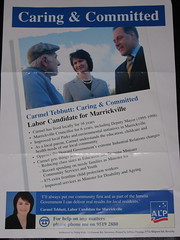
Following NSW Premier Bob Carr's resignation there are a number of NSW bi-elections including one in the electorate of Marrickville. The labor candidate for Marrickville is Carmel Tebbutt who held the portfolio of Education and Training Minister under Premier Carr.
I urge all voters in the Marrickville electorate to consider Tebbutt's record on being "Caring and Committed" before giving your vote to her. As the Minister of Education and Training Minister, Carmel Tebbutt banned an education resource as part of a sex education program that promoted tolerance to gays and lesbians after "The Daily Telegraph" published a story of one parent complaining to the school about the program. Her reaction was to ban the material and claimed "it was inappropriate." Inappropriate to teach tolerance towards people who are not heterosexual Carmel?
Her reaction has drawn criticism from many including the NSW Teachers Federation, President of the Secondary Principals Council, AIDS Council of Australia and the Sydney Gay and Lesbian Special Interest Group. More details about this story can be found in Adele Horin's piece in the Sydney Morning Herald and also on the NSW Teachers Federation web site.
The NSW Teachers Federation sent a letter over the action as did the President of the Secondary Principals Council, Chris Bonnor who said in his letter that:
"Teachers and especially PD teachers will see the response of the government as simply a disgraceful act of cowardice. Your reported response is even out of step with readers of the Daily Telegraph. When asked 'do you think this subject matter should be taught in schools?' 80 per cent responded 'yes'. Your response certainly does not align well with other government and DET initiatives for dealing with homophobia."
Tebbutt has made it very clear by her actions that her policies, ostensibly promoting a government that is "Caring & Committed", do not extend to promoting social tolerance to gays and lesbians. Far from reducing the level of homophobia in our society, her actions will reinforce it. How ironic and how disappointing, when Marrickville Council has one of the highest proportions of gays and lesbians than just about any electorate in Australia. So much for putting "our community first" Carmel...
Friday, August 19, 2005
Meeting with supervisor
Met up with my supervisor yesterday. It wasn't a brainstorm like our previous meetings but it did help me to get a few ideas on how to proceed with my PhD now that I've finished my Confirmation of Candidature. I've been feeling a bit adrift and unmotivated since completing the COC document and presenting it to the panel of academics. It's such a weird thing, doing a PhD. In some ways, you would think there would be very clear procedures to follow given how many have come before you and yet, while there are some guidelines to follow, it is still a very open and organic process that must be re-invented from scratch each time, shaped by the particular research and person undertaking it. It is one of the least prescribed activities I can think of, yet paradoxically replete with many antiquated conventions, making it wondruous, exasperating and a constant act of discovery.
I booked the ticket to Stockholm yesterday and my departure date is October 8th. I still have to sort out my accommodation and some other details. I've been thinking of some ideas for a paper to work on in Sweden but I want whatever I work on to be directly relevant to my PhD. My supervisor put forward a helpful suggestion to undertake an inquiry into the research methodology for my project to try to work through some of the issues that remain unresolved. I like this idea because it does have a wider application as well - studying the social dimensions of ICT use in organisations is still relatively new and many researchers working in this area have experimented with methodologies to try to address questions that are not so easily gathered through traditional means. It would be helpful to examine the approaches taken, why they have been taken and consider some of the issues that researchers have had in grappling with how you research people and technology in action.
I booked the ticket to Stockholm yesterday and my departure date is October 8th. I still have to sort out my accommodation and some other details. I've been thinking of some ideas for a paper to work on in Sweden but I want whatever I work on to be directly relevant to my PhD. My supervisor put forward a helpful suggestion to undertake an inquiry into the research methodology for my project to try to work through some of the issues that remain unresolved. I like this idea because it does have a wider application as well - studying the social dimensions of ICT use in organisations is still relatively new and many researchers working in this area have experimented with methodologies to try to address questions that are not so easily gathered through traditional means. It would be helpful to examine the approaches taken, why they have been taken and consider some of the issues that researchers have had in grappling with how you research people and technology in action.
Tuesday, August 16, 2005
The meaning of a ship
Two news stories have recently caught my interest. The first is the story of the Australian PM granting $1.3 million dollars to the search for an Australian warship sunk 64 years ago during WWII. The other story I heard on TV last night - the Tasmanian government is apparently planning to sink a ship off the East coast of Tasmania to lure scuba divers to the state in an effort to increase tourism. Curiously, today I can't find any references to this latter story on any of the news services. Anyway, I can't stop thinking about these reports announced 24 hours of each other.
What intrigues me about these stories has something to do with the absurd - in the case of the search for the sunken HMAS Sydney II, the absurdity of spending significant amounts of public money to benefit a small group of Australians in order that they can obtain "closure" about an incident that occurred over half a century ago while at the same time the government is drastically reducing funding to public services. Of course, this announcement by the Federal government was designed to convey a message to a much broader group of Australians - to make sense of war by summoning notions of meaningful sacrifice and the solving of a national mystery (literally bringing to light decisive evidence of who was to blame) to redress the growing public dis-ease about the senselessness of a war on terror (where there is no clear and decisive enemy.)
I think the absurdity might also have to do with the coincidence of these announcements (I'm just trying to work this all out so pardon the rambling thoughts). It is absurd to spend public money on the search for a sunken ship and then spend more money to sink another ship. Yet, would these events be absurd if they were not announced on the same day? I have got so used to the Federal government announcements appearing to have a coherent and unified front that the appearance of these two stories by different arms/heads of the government (State and Federal) appears as a rupture in the usual smooth orchestration of the media by the Federal government. The coincidence reveals an official image more akin to the Greek mythological figure of Hydra with its many heads competing in strange and contradictory ways. What is disturbing is how hard it is to to detect these disturbances in the rythmns of the daily news? Of course Hydra is frequently exposed by media commentators and bloggers but it is rare to experience Hydra first hand - to see two of its heads emerge from normally unruffelled waters. Would I be being overly conspiratorial to suspect the sudden disappearance of the story of Tasmania's plans to sink a ship, submerged like an old wreck, its meaning lost to the world?
What intrigues me about these stories has something to do with the absurd - in the case of the search for the sunken HMAS Sydney II, the absurdity of spending significant amounts of public money to benefit a small group of Australians in order that they can obtain "closure" about an incident that occurred over half a century ago while at the same time the government is drastically reducing funding to public services. Of course, this announcement by the Federal government was designed to convey a message to a much broader group of Australians - to make sense of war by summoning notions of meaningful sacrifice and the solving of a national mystery (literally bringing to light decisive evidence of who was to blame) to redress the growing public dis-ease about the senselessness of a war on terror (where there is no clear and decisive enemy.)
I think the absurdity might also have to do with the coincidence of these announcements (I'm just trying to work this all out so pardon the rambling thoughts). It is absurd to spend public money on the search for a sunken ship and then spend more money to sink another ship. Yet, would these events be absurd if they were not announced on the same day? I have got so used to the Federal government announcements appearing to have a coherent and unified front that the appearance of these two stories by different arms/heads of the government (State and Federal) appears as a rupture in the usual smooth orchestration of the media by the Federal government. The coincidence reveals an official image more akin to the Greek mythological figure of Hydra with its many heads competing in strange and contradictory ways. What is disturbing is how hard it is to to detect these disturbances in the rythmns of the daily news? Of course Hydra is frequently exposed by media commentators and bloggers but it is rare to experience Hydra first hand - to see two of its heads emerge from normally unruffelled waters. Would I be being overly conspiratorial to suspect the sudden disappearance of the story of Tasmania's plans to sink a ship, submerged like an old wreck, its meaning lost to the world?
Friday, August 12, 2005
Power tools
An interesting aside to an interesting discussion on a blog I visit brought up the question of power tools. It occurred to me that I have never explained the photo of me in my profile. Though difficult to detect, slung over my shoulder, is an ice pick and bag of crampons. This is me moments before ascending Fox glacier in the south island of New Zealand last December. Ice is a dazzling medium and it evokes for me a feeling I have trouble expressing in words but will give it a go...the mix of hardness and softness, of permanence and transience - its power to shift mountains, valleys and forests and its ephemerality like so many streams and rivulets after a heavy rain. The silence of ice from afar, surveying its form, hulking as it bears down on the world. The roar from up close, wet and cold against its weeping flesh, voices of its disintegration as it breaks off and runs into cracks, fissures and the black sticky mass of its captured debris. I love its ugly gritty frozen lasting crying fragile hard cold solitary mix of mountain sky earth body water flow wind dark light ness. It reminds me of so many things.
Wednesday, August 10, 2005
Last day of Master Class
The master class finished today at lunchtime. The last three days have been very stimulating and challenging. Although I felt a bit overwhelmed and a bit daunted on the first day, I warmed up and warmed to Michael Herzfeld over the duration of the Master Class. There were approximately 25-30 people who attended the class from many different Universities around Australia. Professor Herzfeld is the Head of Anthropology at Harvard University and there were a number of anthropologists attending and a distinct majority of the class were women, at around 88%.
At first I found some of the ideas quite difficult to follow. It was not the lack of anthropological background as the class and its content were interdisciplinary and most of the writers referred to in his talk were either a little bit familiar to me or I'd come across their ideas. As much as I enjoyed listening to Michael talk and was impressed by his encyclopedic knowledge of Greece and the rest of the world, I felt at times like I was getting lost in the back streets and side alleys drifting away from his point as he eloquently roamed through the history, politics and cultures of a vast number of countries. I felt a little frustrated that I couldn't immediately access and grasp the concepts. However, by the second day I felt their meaning and application slowly creeping up on me. By the end of the second day and particularly the third I started to get a hang of the model and the ideas and to consider potential applications of them to my own topic area. I also really enjoyed talking to the other students and since many of them are further along in their research process than myself, it was particularly valuable to hear about their experiences and their reflections.
This evening I was talking with my partner. A story she told me reminded me of an example that I think illustrates the concept of cultural intimacy and social poetics at work. I thought I'd articulate it in my blog to see how well it applies. When I worked in IT providing technical support, it was not uncommon for other techies and myself to laugh and joke about the stupidities of clients who called up for help. This joking was something that we were embarrassed about. On some level, we felt that it wasn't something we should do. I recall us debating this regularly. We were conscious of its effects. It's immediate effect was to release tension and this was certainly felt to be needed, particularly after experiencing a difficult and abusive call. But on reflection we identified how it reinforced the barrier between the public and the organisation and so we sparingly resorted to this practice.
Reflecting on this now in terms of cultural intimacy, I can see how, by calling the client 'stupid' and 'dumb', the client is metaphorically and literally put down and separated from the group. 'Put down', in the sense of disparaged but also in the very physical sense of setting the client apart from the organisation embodied in the act of putting the phone down and disconnecting. The jokes and laughter have a personal and a social function. They bring individual staff close to each other and unite them in the process of distancing the client and putting them in their place. The group gains solidarity through these acts. But the release of tension as expressed through jokes goes further than just reinforcing the 'us' and 'them' relationship between the staff and the client. The effect of the cultural intimacy amongst the techies defined by the shared customs used to release tension also normalises the behaviour of the client through a process of naming and classification. 'The dumb one', 'the crazy one' - each client falls into a category, and in the process they are classified and domesticated into a taxonomy that applies to everyone. We are all crazy and dumb at times.
The function of the release valve works to dynamically construct the inside and the outside but it also reproduces the social relation itself at an individual and at an organisational level, by normalising errant behaviour and incorporating it into the order of the group. I think, and could be way off here but I think this process describes social poetics in action.
At first I found some of the ideas quite difficult to follow. It was not the lack of anthropological background as the class and its content were interdisciplinary and most of the writers referred to in his talk were either a little bit familiar to me or I'd come across their ideas. As much as I enjoyed listening to Michael talk and was impressed by his encyclopedic knowledge of Greece and the rest of the world, I felt at times like I was getting lost in the back streets and side alleys drifting away from his point as he eloquently roamed through the history, politics and cultures of a vast number of countries. I felt a little frustrated that I couldn't immediately access and grasp the concepts. However, by the second day I felt their meaning and application slowly creeping up on me. By the end of the second day and particularly the third I started to get a hang of the model and the ideas and to consider potential applications of them to my own topic area. I also really enjoyed talking to the other students and since many of them are further along in their research process than myself, it was particularly valuable to hear about their experiences and their reflections.
This evening I was talking with my partner. A story she told me reminded me of an example that I think illustrates the concept of cultural intimacy and social poetics at work. I thought I'd articulate it in my blog to see how well it applies. When I worked in IT providing technical support, it was not uncommon for other techies and myself to laugh and joke about the stupidities of clients who called up for help. This joking was something that we were embarrassed about. On some level, we felt that it wasn't something we should do. I recall us debating this regularly. We were conscious of its effects. It's immediate effect was to release tension and this was certainly felt to be needed, particularly after experiencing a difficult and abusive call. But on reflection we identified how it reinforced the barrier between the public and the organisation and so we sparingly resorted to this practice.
Reflecting on this now in terms of cultural intimacy, I can see how, by calling the client 'stupid' and 'dumb', the client is metaphorically and literally put down and separated from the group. 'Put down', in the sense of disparaged but also in the very physical sense of setting the client apart from the organisation embodied in the act of putting the phone down and disconnecting. The jokes and laughter have a personal and a social function. They bring individual staff close to each other and unite them in the process of distancing the client and putting them in their place. The group gains solidarity through these acts. But the release of tension as expressed through jokes goes further than just reinforcing the 'us' and 'them' relationship between the staff and the client. The effect of the cultural intimacy amongst the techies defined by the shared customs used to release tension also normalises the behaviour of the client through a process of naming and classification. 'The dumb one', 'the crazy one' - each client falls into a category, and in the process they are classified and domesticated into a taxonomy that applies to everyone. We are all crazy and dumb at times.
The function of the release valve works to dynamically construct the inside and the outside but it also reproduces the social relation itself at an individual and at an organisational level, by normalising errant behaviour and incorporating it into the order of the group. I think, and could be way off here but I think this process describes social poetics in action.
Friday, August 05, 2005
"Cultural Intimacy"
Currently wading through what has accurately been described as a 'tome' of readings for a Master Class I'm attending next Monday, Tuesday and Wednesday on "Cultural Intimacy and Social Poetics: a new agenda for cultural research". I found out recently in an email that all students participating will be required to be 'rapporteurs'. What the hell is a rapporteur? I was intrigued by this word which resonated of French and possibly medieval origins.
The image that first came to mind was a cross between someone who goes to restaurants alot and a very fast moving and lethal ground-dwelling dinosaur of the Jurassic period. However, I discovered upon looking it up in dictionary.com that rapporteur has a rather more mundane meaning of being one who "is designated to give a report, as at a meeting." Definately no food or violent acts involved by the sounds of it, unless we are referring figuratively and a bit dramatically to the verbal assaults that can be delivered at meeting room tables. The rapporteur is someone who brings back as in portare "to carry", an account, in this case to the other meeting participants, although in our case it is being applied to mean that the rapporteur will suggest ways in which the readings and the discussion link with local interests as well as taking notes and outlining the main points and directions at the end of the session.
The whole thing is just making me feel very nervous I have to say and I'm a little concerned that if called upon, I may, as local rapporteur, become the rapporteur of my imagination delivering a belching, gutteral, stuttering and beastly display, rather than the professional, calm and academic performance that will be expected.
The image that first came to mind was a cross between someone who goes to restaurants alot and a very fast moving and lethal ground-dwelling dinosaur of the Jurassic period. However, I discovered upon looking it up in dictionary.com that rapporteur has a rather more mundane meaning of being one who "is designated to give a report, as at a meeting." Definately no food or violent acts involved by the sounds of it, unless we are referring figuratively and a bit dramatically to the verbal assaults that can be delivered at meeting room tables. The rapporteur is someone who brings back as in portare "to carry", an account, in this case to the other meeting participants, although in our case it is being applied to mean that the rapporteur will suggest ways in which the readings and the discussion link with local interests as well as taking notes and outlining the main points and directions at the end of the session.
The whole thing is just making me feel very nervous I have to say and I'm a little concerned that if called upon, I may, as local rapporteur, become the rapporteur of my imagination delivering a belching, gutteral, stuttering and beastly display, rather than the professional, calm and academic performance that will be expected.
Wednesday, August 03, 2005
Confirmation of Candidature
I completed and passed my Confirmation of Candidature yesterday. It went pretty well and though the panel raised some concerns about the number and selection of research sites, I felt that they were voicing my own thoughts on this matter. They provided some very valuable suggestions. I'm glad I recorded the meeting on digital voice recorder. I was concentrating so much on the presentation, the questions from the panel and the proceedings in general that I would never have been able to take coherent notes as well.
This morning I slept in for the first time since starting my PHD. My dog was pretty happy about that and slept blissfully under the doona without stirring until I eventually rolled out of bed at about 10am.
I'm not feeling quite as exposed today as I did last night, a feeling I always get whenever I deliver a verbal presentation or do something personally challenging that involves a public performance. Fortunately, the panel was very supportive and encouraging and the proceedings, while formal, were not clinical.
I know I need to address some of the problem areas of my research proposal next but I think I might give myself a little breather today...go food shopping, clean up the house a bit, return an overdue library book, read the paper, admire the built-in wardrobes, that sort of thing.
I met up with two of the staff of my old business on Saturday night. It was so great to catch up with them and talk and feel that our lives are still connected but in a new and reinvigorated way. It was very meaningful to me.
This morning I slept in for the first time since starting my PHD. My dog was pretty happy about that and slept blissfully under the doona without stirring until I eventually rolled out of bed at about 10am.
I'm not feeling quite as exposed today as I did last night, a feeling I always get whenever I deliver a verbal presentation or do something personally challenging that involves a public performance. Fortunately, the panel was very supportive and encouraging and the proceedings, while formal, were not clinical.
I know I need to address some of the problem areas of my research proposal next but I think I might give myself a little breather today...go food shopping, clean up the house a bit, return an overdue library book, read the paper, admire the built-in wardrobes, that sort of thing.
I met up with two of the staff of my old business on Saturday night. It was so great to catch up with them and talk and feel that our lives are still connected but in a new and reinvigorated way. It was very meaningful to me.
Thursday, July 28, 2005
Scholarship approved!
Well I'm pretty stoked. I found out the other day that I have been offered the International Scholarship to go to Sweden. Wow! I'm also pretty nervous and the wave of panic associated with my fear of flying hit me about 1.5 seconds after the wave of excitement upon finding out. I'm seriously considering attending one of those desensitising workshops at the airport. The only problem is they cost a bomb. Oh I so shouldn't use that word!
My proposed research for this Scholarship is an enquiry into innovations in mobile office technology by the two cellphone companies – Ericsson, of Sweden and Nokia, of Finland. The scholarship will provide me with an opportunity to conduct fieldwork for the final chapter of my PHD dissertation on mobile technologies and the ‘the office of the future’. It will also result in a series of papers and articles exploring the cultural, historical and geographical roots and context of these key mobile technology enterprises. The research will involve a visit to the headquarters of Ericsson and Nokia, which accommodate the R&D departments of both companies, to tour their facilities and conduct an interview with the design teams.
My proposed research for this Scholarship is an enquiry into innovations in mobile office technology by the two cellphone companies – Ericsson, of Sweden and Nokia, of Finland. The scholarship will provide me with an opportunity to conduct fieldwork for the final chapter of my PHD dissertation on mobile technologies and the ‘the office of the future’. It will also result in a series of papers and articles exploring the cultural, historical and geographical roots and context of these key mobile technology enterprises. The research will involve a visit to the headquarters of Ericsson and Nokia, which accommodate the R&D departments of both companies, to tour their facilities and conduct an interview with the design teams.
Wednesday, July 20, 2005

Tuesday, July 19, 2005
twilight
The sky is fading, the blue leeched out of it like an ancient pair of stone washed jeans. The light that's left clings to the roof tops. I sit at my desk looking out at the street through the narrow terrace windows with their horizontal bars. The ink of night seems to be seeping up from the earth, erasing all detail from the gum trees and houses...oh geez, that's enough...it's dark already.
Feeling much better. My cold is almost gone. Unfortunately I passed it on to my partner who came down with it quite severely and then just as she was recovering, an opportunistic stomache virus seemed to slip in and caught her unawares. She has been really sick the last few days but is back to work today.
Meanwhile I have had bursts of energy that I've spent on preparing and painting two walls, one in the study and one in the bedroom, prior to the installation of our built in wardrobes that are being installed tomorrow!!
I'm very excited about this. Yes, storage does make me happy. The days of living with piles of boxes in the corner of each room will be over. I do like things to be put away but I'm not really fussed about cleanliness. A bit of dirt here and there, that's OK, it doesn't bother me but I really don't like clutter and mess. Where I got this preference for things being in their place is not very hard to imagine. I have tempered my mum's love of all things neat, clean and tidy to just focus on the neat and tidy bit and have rebelled against the clean.
Yesterday I handed in my application for a Postgraduate Scholarship in Sweden to take place later this year. I was in two minds about whether to apply and decided that I would focus on the application as a process in itself and I'm glad I did this because it has clarified my ideas about my PHD thesis and made me reflect on how the stuff I'm learning and researching can be applied to other outcomes such as seminar and conference papers. However, I remain concerned I may not be able to afford eight weeks in Sweden and then another month in the UK when I could be in Australia conducting field work. Three years is such a short time to do a thesis. It only really makes sense if I can justify the trip based on its direct relevance to my PHD, in terms of material collected and research conducted. Well, I did it anyway, and who knows whether I will be successful or not. My philosophy is to make the most of every opportunity and experience because it is only three years and though it may very well result in a better thesis to spend the entire time with my head down reading and focusing on my research, I want to experience more than that during my PHD.
Talking about reading, at the moment I'm reading Kenneth Gergen's "The Saturated Self" and "Emotions in Social Life", an anthology of writings on the emerging field of sociology of emotions. I'm also dipping into "The Social Shaping of Technology" to reacquaint myself with some of the social constructivist approaches to technology. I need to finalise my confirmation of candidature document and have sort of drifted away from the headspace I was in when I wrote it. My supervisor is arranging the committee presentation date for the first week of August. Small wave of panic...
Feeling much better. My cold is almost gone. Unfortunately I passed it on to my partner who came down with it quite severely and then just as she was recovering, an opportunistic stomache virus seemed to slip in and caught her unawares. She has been really sick the last few days but is back to work today.
Meanwhile I have had bursts of energy that I've spent on preparing and painting two walls, one in the study and one in the bedroom, prior to the installation of our built in wardrobes that are being installed tomorrow!!
I'm very excited about this. Yes, storage does make me happy. The days of living with piles of boxes in the corner of each room will be over. I do like things to be put away but I'm not really fussed about cleanliness. A bit of dirt here and there, that's OK, it doesn't bother me but I really don't like clutter and mess. Where I got this preference for things being in their place is not very hard to imagine. I have tempered my mum's love of all things neat, clean and tidy to just focus on the neat and tidy bit and have rebelled against the clean.
Yesterday I handed in my application for a Postgraduate Scholarship in Sweden to take place later this year. I was in two minds about whether to apply and decided that I would focus on the application as a process in itself and I'm glad I did this because it has clarified my ideas about my PHD thesis and made me reflect on how the stuff I'm learning and researching can be applied to other outcomes such as seminar and conference papers. However, I remain concerned I may not be able to afford eight weeks in Sweden and then another month in the UK when I could be in Australia conducting field work. Three years is such a short time to do a thesis. It only really makes sense if I can justify the trip based on its direct relevance to my PHD, in terms of material collected and research conducted. Well, I did it anyway, and who knows whether I will be successful or not. My philosophy is to make the most of every opportunity and experience because it is only three years and though it may very well result in a better thesis to spend the entire time with my head down reading and focusing on my research, I want to experience more than that during my PHD.
Talking about reading, at the moment I'm reading Kenneth Gergen's "The Saturated Self" and "Emotions in Social Life", an anthology of writings on the emerging field of sociology of emotions. I'm also dipping into "The Social Shaping of Technology" to reacquaint myself with some of the social constructivist approaches to technology. I need to finalise my confirmation of candidature document and have sort of drifted away from the headspace I was in when I wrote it. My supervisor is arranging the committee presentation date for the first week of August. Small wave of panic...
Friday, July 08, 2005
bad cold and rambling thoughts
Not quite so early at the desk this morning. It's 10.31 am.
I shouldn't really be here at all but in bed. My sore throat has evolved into a pretty bad cold and I have all the undesirable symptoms that go with it - running nose, headache, sore shoulders, sneezes, watering eyes. Oh how lovely.
It's a wet and cold day too and snowing in Kosciusko at last check. Sometimes, like today, you can guess that it's snowing because the temperature drops and there is a chill in the air that feels like it's come off the mountains and travelled down to the coast.
Stayed up a little later than I intended last night watching for any updates on the blasts in London. My partner's sister is in London and we were in contact with her via email to make sure she was OK.
It seems very surreal, from Sydney. I can imagine it must feel very unworldly for Londoners. I've checked the BBC web site and Sydney's ABC web site. The Internet seems to come into its own during incidents such as this. One Londoner put it, "the Internet has been my window into the world during this event". I've been thinking a bit about what is different about it. What is it about the Internet and its uses today that means that during an emergency incident, it takes on a more significant role than it ordinarily does, particularly in relation to other media? My thoughts on this are a kind of cold affected ramble through the myriad of ways of thinking about this topic.
Partly, from a production perspective, the ability to deliver information rapidly and without interruption are both critical functions of the media during an emergency event. The Internet seems to enable the collection, composition and delivery of information from distributed sites and additionally, requires less orchestration that other media forms. This means it doesn't rely on as many punctuated points in the production process. Punctuated points can be knocked out easily as a result of interrupted or partial network services, and this can effect the delivery of information anywhere along the production path. These characteristics of the Internet give it an advantage over other media forms during the coverage of an emergency incident.
The other difference is that the Internet facilitates the collection and delivery of multiple media forms without the same requirement for it to be 'packaged' or bundled to the same extent as other media forms.
Let's look at broadcast television. You do see quite a bit of improvisation - rough and ready camera footage, extra heads and torsos appearing in frame occasionally and people wandering in and out of conversations while they are being filmed. Increasingly too, you see the incorporation of other media into the live broadcast such as personal hand held videos (the coverage of 9/11 relied heavily on personal videos). You could even argue that these aspects operate as the signature of the 'live emergency event' and perhaps define it as a genre. Ultimately though, stories are still required to be assembled and delivered ('bundled') into the rather narrow parameters of what has become expected of this media form over its lifetime.
The Internet as a media form, on the other hand, does not have quite the same limitations. It facilitates the use of data from a much broader set of media forms such as text from sms, chat, images and sound from photos and video and the composition of this data in multiple mediums (web, chat, video, radio etc) and in multiple formats (news web site, blog). This means a media response can be formulated in a broader set of spatial and temporal configurations and it can be delivered more rapidly.
So while you could argue that during the broadcast of an emergency incident, television and radio operate under a changed set of conditions and with different expectations, and that this gives these media forms more latitude for impromptu improvisation, I argue (for the sake of this exercise at any rate), that the Internet is not as 'bundled' and furthermore, because it cannot be conceived as a single medium, its properties allow it to perform an extra ordinary role in the emergency event.
However, all of these characteristics really only makes a difference for the information producer. Access to the Internet can be just as disrupted as other telecommunication services, with ultimately the same result for the end user or consumer. One of the other aspects of the Internet as a media form during the emergency event, is that it can perform multiple purposes. It can act like a poster or billboard, as a news channel, commentary site, collection of personal experiences to name a few examples. These interventions into the emergency event support and create a different set of relationships between the information producer and information consumer than that of other media forms.
So to wind up this rather long winded ramble, perhaps the defining differences come down to two main factors;
- the Internet as a media form, must be understood not a single media that requires the conditioning and framing of information into a single broadcast stream, but as a multicast platform with multiple data streams.
- the Internet is, partly because of its multicast technical properties described above and partly because it is less bundled or 'packaged' can:
* deliver information more rapidly
* be less prone to interruption or disruption in the production and delivery of information
* perform mutiple purposes or roles
All of these contribute to the emergence of a different set of relationships between the information producer and consumer and gives the Internet an extra ordinary role in relation to other media during the emergency event.
I shouldn't really be here at all but in bed. My sore throat has evolved into a pretty bad cold and I have all the undesirable symptoms that go with it - running nose, headache, sore shoulders, sneezes, watering eyes. Oh how lovely.
It's a wet and cold day too and snowing in Kosciusko at last check. Sometimes, like today, you can guess that it's snowing because the temperature drops and there is a chill in the air that feels like it's come off the mountains and travelled down to the coast.
Stayed up a little later than I intended last night watching for any updates on the blasts in London. My partner's sister is in London and we were in contact with her via email to make sure she was OK.
It seems very surreal, from Sydney. I can imagine it must feel very unworldly for Londoners. I've checked the BBC web site and Sydney's ABC web site. The Internet seems to come into its own during incidents such as this. One Londoner put it, "the Internet has been my window into the world during this event". I've been thinking a bit about what is different about it. What is it about the Internet and its uses today that means that during an emergency incident, it takes on a more significant role than it ordinarily does, particularly in relation to other media? My thoughts on this are a kind of cold affected ramble through the myriad of ways of thinking about this topic.
Partly, from a production perspective, the ability to deliver information rapidly and without interruption are both critical functions of the media during an emergency event. The Internet seems to enable the collection, composition and delivery of information from distributed sites and additionally, requires less orchestration that other media forms. This means it doesn't rely on as many punctuated points in the production process. Punctuated points can be knocked out easily as a result of interrupted or partial network services, and this can effect the delivery of information anywhere along the production path. These characteristics of the Internet give it an advantage over other media forms during the coverage of an emergency incident.
The other difference is that the Internet facilitates the collection and delivery of multiple media forms without the same requirement for it to be 'packaged' or bundled to the same extent as other media forms.
Let's look at broadcast television. You do see quite a bit of improvisation - rough and ready camera footage, extra heads and torsos appearing in frame occasionally and people wandering in and out of conversations while they are being filmed. Increasingly too, you see the incorporation of other media into the live broadcast such as personal hand held videos (the coverage of 9/11 relied heavily on personal videos). You could even argue that these aspects operate as the signature of the 'live emergency event' and perhaps define it as a genre. Ultimately though, stories are still required to be assembled and delivered ('bundled') into the rather narrow parameters of what has become expected of this media form over its lifetime.
The Internet as a media form, on the other hand, does not have quite the same limitations. It facilitates the use of data from a much broader set of media forms such as text from sms, chat, images and sound from photos and video and the composition of this data in multiple mediums (web, chat, video, radio etc) and in multiple formats (news web site, blog). This means a media response can be formulated in a broader set of spatial and temporal configurations and it can be delivered more rapidly.
So while you could argue that during the broadcast of an emergency incident, television and radio operate under a changed set of conditions and with different expectations, and that this gives these media forms more latitude for impromptu improvisation, I argue (for the sake of this exercise at any rate), that the Internet is not as 'bundled' and furthermore, because it cannot be conceived as a single medium, its properties allow it to perform an extra ordinary role in the emergency event.
However, all of these characteristics really only makes a difference for the information producer. Access to the Internet can be just as disrupted as other telecommunication services, with ultimately the same result for the end user or consumer. One of the other aspects of the Internet as a media form during the emergency event, is that it can perform multiple purposes. It can act like a poster or billboard, as a news channel, commentary site, collection of personal experiences to name a few examples. These interventions into the emergency event support and create a different set of relationships between the information producer and information consumer than that of other media forms.
So to wind up this rather long winded ramble, perhaps the defining differences come down to two main factors;
- the Internet as a media form, must be understood not a single media that requires the conditioning and framing of information into a single broadcast stream, but as a multicast platform with multiple data streams.
- the Internet is, partly because of its multicast technical properties described above and partly because it is less bundled or 'packaged' can:
* deliver information more rapidly
* be less prone to interruption or disruption in the production and delivery of information
* perform mutiple purposes or roles
All of these contribute to the emergence of a different set of relationships between the information producer and consumer and gives the Internet an extra ordinary role in relation to other media during the emergency event.
Tuesday, July 05, 2005
nice day but sore throat
Crisp, cloudless morning...at my desk by 9.10am.
I sent off my Confirmation of Candidature (COC) document to my supervisor a few days ago. I know I could do more work on it but am now wondering if I should set it aside and start focusing on the next task at hand. I think that's the Ethics Application. Also, I think I have outgrown the format and structure of the COC in terms of developing my ideas. The thought of the thesis being the next structure to start working on is pretty frightening. I'm hoping that the presentation of the COC to the committee panel will give me some solid feedback on the research. I don't feel like I've quite got the research design sorted out. I still need to locate my research sites and I think the research questions may still be a bit vague and un-anchored somehow.
The cat is stretched out on top of my monitor. She seems to have put on a little bit of a winter tum which is sort of drooping over the top of the display at the moment and obscuring the menu on my desktop. The dog meanwhile is curled up in her bed next to the heater to my left.
My throat is really sore this morning and all my glands are up. I'm finding it hard to focus on my readings. I'm working through "Virtual Society? Technology, Cyberbole, Reality" edited by Steve Woolgar at the moment.
I sent off my Confirmation of Candidature (COC) document to my supervisor a few days ago. I know I could do more work on it but am now wondering if I should set it aside and start focusing on the next task at hand. I think that's the Ethics Application. Also, I think I have outgrown the format and structure of the COC in terms of developing my ideas. The thought of the thesis being the next structure to start working on is pretty frightening. I'm hoping that the presentation of the COC to the committee panel will give me some solid feedback on the research. I don't feel like I've quite got the research design sorted out. I still need to locate my research sites and I think the research questions may still be a bit vague and un-anchored somehow.
The cat is stretched out on top of my monitor. She seems to have put on a little bit of a winter tum which is sort of drooping over the top of the display at the moment and obscuring the menu on my desktop. The dog meanwhile is curled up in her bed next to the heater to my left.
My throat is really sore this morning and all my glands are up. I'm finding it hard to focus on my readings. I'm working through "Virtual Society? Technology, Cyberbole, Reality" edited by Steve Woolgar at the moment.
Wednesday, June 29, 2005
growling and brawling
The dogs are up to no good today. Must be the weather. It's been raining for about a week and everyone is feeling a bit cooped up and damp. The house has that sort of steaming clothes odour and the living room looks like a laundry, clothes hanging over every surface to dry. Really, we are not prepared for this sort of weather in Sydney. I've never had so many undie crisis in one week! It's rare to not be able to hang out your clothes to dry outside. Now I understand why people have dryers. How do people live like this? :-)
Wow, another downpour....impressive.
My blood pressure went up this morning. A bunch of council goons were hacking at the trees in the street. Not just grooming them but hacking off primary limbs (does that make sense? I'm no arborist!). Now I understand if they must trim the branches occasionally to keep them from growing into the electricity cables. However, these guys were butchering the trees. My heart beating madly and my head slightly throbbing (I always get a headache when I get cross), I went outside and as politely as I could asked them what the f*&^% they were doing. They told me they were responding to a complaint. A complaint? A complaint about low lying branches. A complaint about low lying branches? Since when has the council responded to a single complaint? I was flabbergasted and spent the next 30 minutes trying to get through to the Head Tree Manager at the local council to make my own complaint. I wondered if they might respond so enthusiastically to my complaint. I don't think so. Can't image big gang of goons coming down quite so keenly to stick the branches back on. I can't help thinking that there is an unwritten bias towards destruction in the council's policies. It is so much easier to come and cut down a bunch of trees than it is to develop a plan, for say, building a cable trench in the street so that all the trees can grow without fear of reprisal. OK, so I understand this is possibly not the most life and death issue. I can get very worked up about trees. My partner has suggested that I have querulant tendencies. Is that a good word or what? Do you like that word? A querulant is, you could say, a professional complainer. You know, the sad thing is, I could really see myself being a querulant - if I had the time!!
Almost finished my confirmation of candidature document. It's been a really interesting process writing it and I've had to do a lot of thinking about the project. I'm going to try and polish a couple of the sections today and then give my supervisor a revised draft tomorrow.
There is a master class that I've signed up for in August that focuses on strategies for approaching fieldwork. It's excellent timing since I hope to start the fieldwork later this year.
Wow, another downpour....impressive.
My blood pressure went up this morning. A bunch of council goons were hacking at the trees in the street. Not just grooming them but hacking off primary limbs (does that make sense? I'm no arborist!). Now I understand if they must trim the branches occasionally to keep them from growing into the electricity cables. However, these guys were butchering the trees. My heart beating madly and my head slightly throbbing (I always get a headache when I get cross), I went outside and as politely as I could asked them what the f*&^% they were doing. They told me they were responding to a complaint. A complaint? A complaint about low lying branches. A complaint about low lying branches? Since when has the council responded to a single complaint? I was flabbergasted and spent the next 30 minutes trying to get through to the Head Tree Manager at the local council to make my own complaint. I wondered if they might respond so enthusiastically to my complaint. I don't think so. Can't image big gang of goons coming down quite so keenly to stick the branches back on. I can't help thinking that there is an unwritten bias towards destruction in the council's policies. It is so much easier to come and cut down a bunch of trees than it is to develop a plan, for say, building a cable trench in the street so that all the trees can grow without fear of reprisal. OK, so I understand this is possibly not the most life and death issue. I can get very worked up about trees. My partner has suggested that I have querulant tendencies. Is that a good word or what? Do you like that word? A querulant is, you could say, a professional complainer. You know, the sad thing is, I could really see myself being a querulant - if I had the time!!
Almost finished my confirmation of candidature document. It's been a really interesting process writing it and I've had to do a lot of thinking about the project. I'm going to try and polish a couple of the sections today and then give my supervisor a revised draft tomorrow.
There is a master class that I've signed up for in August that focuses on strategies for approaching fieldwork. It's excellent timing since I hope to start the fieldwork later this year.
Thursday, June 02, 2005
Amazing race
Sitting in the lounge with the powerbook on my lap, thanks to wireless. Cat is on the armchair, one dog on her bed in front of the gas heater and other dog on a pillow on the lounge. Been a bit quiet on the blog front lately. I think I may have got lost in the PHD forest at the base of Mt Fuji. My sister told me it is the deepest, most impenetrable and disorienting forest in Japan. Apparently the army runs orienteering training for their cadets there and many people have got lost. So anyway I felt like I was there and am just emerging from the woods. I've been working on my confirmation of candidature document and it requires formulating and refining my research area. It's been a challenging process particularly since I haven't studied for so long. Last time I wrote anything academic was over ten years ago. I love all the readings I'm doing though. I could easily just read for three years but I don't think that's recommended...
Thursday, May 12, 2005
Two dogs
We're looking after another dog at the moment, a little black and white fox terrier. She's pretty cute. During the day while I'm studying, I have both dogs in the room with me. Most of the time they sleep in their beds by my desk but sometimes they get restless and rumble with each other and make a racket.
They've kept me company during this rather stucky blocked time I've been having with my PHD. It's been quite frustrating and has lasted for about two weeks. I'm trying to formulate my research questions and research statement and it just isn't happening. Well actually, I've written about 3 or 4 versions and am just churning over the same stuff.
Aside from the stuckness I'm currently experiencing, I have made some progress on other fronts. I'm a lot clearer about the areas of reading I'd like to cover. I've been overwhelmed by the amount of relevant material. Meanwhile I've met with my two other supervisors and both generated some really good discussions and feedback.
I went to Fisher Library yesterday and borrowed a few more books. One of them was written by another of my supervisors a number of years ago. It's still very relevant and is about computer culture and the irrational self. I particularly like the extrapolation of Don Ihde's typology of the human-technology relationship with the addition of the psychoanalytic categories. I came across Ihde's typology recently and have been thinking about them in terms of how they may fit into my own project. It occurred to me recently while browsing Rosalind Picard's "Affective Computing" that her conceptualisation of what a relationship can be in relation to computers and computational objects could benefit from a more nuanced approach to what types of relationships can be formed. She views them primarily in terms of an alterity relation.
They've kept me company during this rather stucky blocked time I've been having with my PHD. It's been quite frustrating and has lasted for about two weeks. I'm trying to formulate my research questions and research statement and it just isn't happening. Well actually, I've written about 3 or 4 versions and am just churning over the same stuff.
Aside from the stuckness I'm currently experiencing, I have made some progress on other fronts. I'm a lot clearer about the areas of reading I'd like to cover. I've been overwhelmed by the amount of relevant material. Meanwhile I've met with my two other supervisors and both generated some really good discussions and feedback.
I went to Fisher Library yesterday and borrowed a few more books. One of them was written by another of my supervisors a number of years ago. It's still very relevant and is about computer culture and the irrational self. I particularly like the extrapolation of Don Ihde's typology of the human-technology relationship with the addition of the psychoanalytic categories. I came across Ihde's typology recently and have been thinking about them in terms of how they may fit into my own project. It occurred to me recently while browsing Rosalind Picard's "Affective Computing" that her conceptualisation of what a relationship can be in relation to computers and computational objects could benefit from a more nuanced approach to what types of relationships can be formed. She views them primarily in terms of an alterity relation.
Sunday, May 01, 2005
IVF in Australia
The Australian Government based on a proposal by the Minister for Health, Tony Abbot, is considering capping the rebates on the number of IVF cycles for women over 42. This reform attempt has got me really bloody peeved and quite worked up. These are the concerns and observations I have about this proposal.
- There have been an increasing number of incursions by the government to regulate and control what women can and should be doing as "reproductive" members of society.
- This recent proposal is divisive and like many of the Federal government's reform policies creates discord within sections of the populace that would otherwise not have had disparate positions by producing an emotional and competitive discourse whereby an extremely narrow 'normative' body and lifestyle is justified against which all other modes of being and bodies are excluded.
- In addition to being about women's bodies, who and how these should be controlled, this is also an issue about Australia's health system, and about how we define what is an elective and non-elective treatment.
Highlighting some of the internal inconsistencies and ruptures of a piece in the Comments section of the Sydney Morning Herald on Friday April 29th reveals some of these issues at work. In her comment piece, Hilary Burden, addresses all women readers in her claim that "If you have trouble conceiving, don't be surprised, don't ask for handouts and don't think it's the end of the world". According to Burden, women are not only arrogant but also selfish and naive to assume that the government will cover the cost of repeated cycles of IVF once over 42. After dishing out on women, all women apparently, as there are no specific references to any actual quotes by women or women's groups on this issue, only a reference to something Emma Thompson once remarked, she ends by saying that no women should "be made to feel they are dependent on what they produce or don't produce with their bodies. In an overpopulated world, you don't have to have a baby to learn how to labour or live."
Hilary is having trouble making sense of all of this. It's "just weird maths", she states, that the Government gives "couples $3000 for having a baby on the one hand and then reduce their chances of having one on the other."
One of the reasons why Hilary is having trouble understanding this is because she is reacting from a position of being a woman who is struggling to be valued in her own right as a productive member of society without necessarily being a reproductive member of society. Unfortunately Hilary, by taking this stance, is colluding with the Federal government's policies, harming her own cause and those of other women who have a broader and more inclusive position that women who choose to work, women who choose to work and have children and women who choose to have children are all deserving of being valued and supported.
In fact, the inconsistency of the Government's stance on these two issues shows the consistency of their belief that underpins all their policies on women's re-productive and productive labour, the notion that only some bodies and only some modes of being in bodies are acceptable and normal and therefore should be supported by Government funding. For though the Australian government is trying to address what it sees as a growing problem of reduced birth rates, leading to an ageing work force, by encouraging reproduction, the social model for achieving this is not simply to make having children and bringing up children easier to all members of society but to reform the social conditions themselves, so that it is made easier only within certain very narrow parameters, i.e. by being young and by being legally infertile. What this excludes are the many choices and conditions under which either of these two parameters are not viable, such as working for the early part of one's life or due to a phsyiological condition which reduces the likelihood of being able to achieve pregnancy without assistance.
And so, finally to my ultimate concern, about Australia's health system. These parameters of eligibility are maintained by making IVF treatments financially inaccessible, and therefore unavailable, to those who fall outside of the narrow definition. Burden asks, "Why is it so bad to be given three attempts at having another child, and after that, you pay for it yourself. Raise the $10,000 amongst your kin..."
Because by supporting access of only those women who are under 42 and legally infertile, to a comprehensive IVF treatment plan, we are not just reducing the overall rates of successful pregnancy, we are reducing the social and life options of all women in Australian society, and impoverishing the diversity of our culture.
- There have been an increasing number of incursions by the government to regulate and control what women can and should be doing as "reproductive" members of society.
- This recent proposal is divisive and like many of the Federal government's reform policies creates discord within sections of the populace that would otherwise not have had disparate positions by producing an emotional and competitive discourse whereby an extremely narrow 'normative' body and lifestyle is justified against which all other modes of being and bodies are excluded.
- In addition to being about women's bodies, who and how these should be controlled, this is also an issue about Australia's health system, and about how we define what is an elective and non-elective treatment.
Highlighting some of the internal inconsistencies and ruptures of a piece in the Comments section of the Sydney Morning Herald on Friday April 29th reveals some of these issues at work. In her comment piece, Hilary Burden, addresses all women readers in her claim that "If you have trouble conceiving, don't be surprised, don't ask for handouts and don't think it's the end of the world". According to Burden, women are not only arrogant but also selfish and naive to assume that the government will cover the cost of repeated cycles of IVF once over 42. After dishing out on women, all women apparently, as there are no specific references to any actual quotes by women or women's groups on this issue, only a reference to something Emma Thompson once remarked, she ends by saying that no women should "be made to feel they are dependent on what they produce or don't produce with their bodies. In an overpopulated world, you don't have to have a baby to learn how to labour or live."
Hilary is having trouble making sense of all of this. It's "just weird maths", she states, that the Government gives "couples $3000 for having a baby on the one hand and then reduce their chances of having one on the other."
One of the reasons why Hilary is having trouble understanding this is because she is reacting from a position of being a woman who is struggling to be valued in her own right as a productive member of society without necessarily being a reproductive member of society. Unfortunately Hilary, by taking this stance, is colluding with the Federal government's policies, harming her own cause and those of other women who have a broader and more inclusive position that women who choose to work, women who choose to work and have children and women who choose to have children are all deserving of being valued and supported.
In fact, the inconsistency of the Government's stance on these two issues shows the consistency of their belief that underpins all their policies on women's re-productive and productive labour, the notion that only some bodies and only some modes of being in bodies are acceptable and normal and therefore should be supported by Government funding. For though the Australian government is trying to address what it sees as a growing problem of reduced birth rates, leading to an ageing work force, by encouraging reproduction, the social model for achieving this is not simply to make having children and bringing up children easier to all members of society but to reform the social conditions themselves, so that it is made easier only within certain very narrow parameters, i.e. by being young and by being legally infertile. What this excludes are the many choices and conditions under which either of these two parameters are not viable, such as working for the early part of one's life or due to a phsyiological condition which reduces the likelihood of being able to achieve pregnancy without assistance.
And so, finally to my ultimate concern, about Australia's health system. These parameters of eligibility are maintained by making IVF treatments financially inaccessible, and therefore unavailable, to those who fall outside of the narrow definition. Burden asks, "Why is it so bad to be given three attempts at having another child, and after that, you pay for it yourself. Raise the $10,000 amongst your kin..."
Because by supporting access of only those women who are under 42 and legally infertile, to a comprehensive IVF treatment plan, we are not just reducing the overall rates of successful pregnancy, we are reducing the social and life options of all women in Australian society, and impoverishing the diversity of our culture.
Subscribe to:
Posts (Atom)